Asphalt driveway repair is the right fix when the damage is local: a few cracks or a pothole on a driveway that is still firm underneath. Resurfacing, a new layer of asphalt over the old one, only works when the existing driveway is still structurally sound. Replacement is needed when the base has failed, which usually shows up as alligator cracking, sunken areas or potholes that keep coming back. The deciding question is always the same: is the problem in the surface, or in the base below it?
This guide explains how to read the damage, what each fix involves, and when a patch or new layer will not last.
Start With the Base, Not the Surface
An asphalt driveway is a thin layer of pavement sitting on a granular base. The Ontario Hot Mix Producers Association (OHMPA) recommends 6 to 8 inches of compacted crushed granular base on a firm subgrade, with at least 2 inches of compacted hot mix asphalt on top. It says a well-designed driveway will give virtually trouble-free service for up to 20 years.
That is why the type of damage matters. Some cracks come from the asphalt shrinking and hardening with age, which is a surface problem. Others come from the base or subgrade losing support, and the sources below say surface treatments do not fix those.
How to Read the Cracks and Damage
Pavement engineers sort damage into types, and the type tells you a lot about the cause. The descriptions below come from the Texas A&M Transportation Institute's pavement distress guide and the Washington Asphalt Pavement Association (WAPA).
Straight cracks running along or across the driveway
Long cracks that run along the driveway (longitudinal) or across it (transverse) are often caused by the asphalt shrinking at low temperatures or hardening with age. The Texas A&M guide says transverse cracks are not usually load associated. On their own, they do not mean the base has failed.
Block cracking
Block cracks divide the surface into rough rectangles, from about 1 foot square up to about 10 feet square. Texas A&M says block cracking is caused mainly by shrinkage and daily temperature cycles, is not load associated, and usually means the asphalt has hardened a lot. The surface is tired, but the base may still be fine. A driveway like this is a candidate for resurfacing if the base checks out.
Alligator cracking
Alligator cracking is a web of small, sharp-angled pieces, usually in the wheel paths. Texas A&M calls it a major structural distress that starts at the bottom of the asphalt under repeated wheel loads. WAPA says the most common cause is a loss of base or subgrade support, from things like poor drainage or spring thaw, and that once the alligator pattern appears, crack sealing is generally ineffective.
Sunken areas and puddles
A depression is a low spot that fills with water after rain. WAPA says depressions come from frost heave or from subgrade settlement caused by poor compaction during construction. Its repair is to remove the asphalt, dig out and replace the poor subgrade, then patch.
Potholes
WAPA describes a pothole as a hole that goes all the way through the asphalt to the base, and says potholes are generally the end result of fatigue cracking. A single pothole can be patched, but a driveway with alligator cracking around it is telling you the base is the real issue.
Option 1: Asphalt Driveway Repair
Repair fixes the damaged spots and leaves the rest alone. It suits a sound driveway with isolated problems.
Crack filling. Fillers are sized for specific crack widths. Resisto's published product chart lists its liquid crack filler for cracks up to 1/4 inch (6 mm), its rubberized crack filler for cracks up to 3/4 inch (20 mm), and its asphalt repair product for holes and cracks of 3/4 inch and larger. Crack filling is for single cracks, not for alligator cracking.
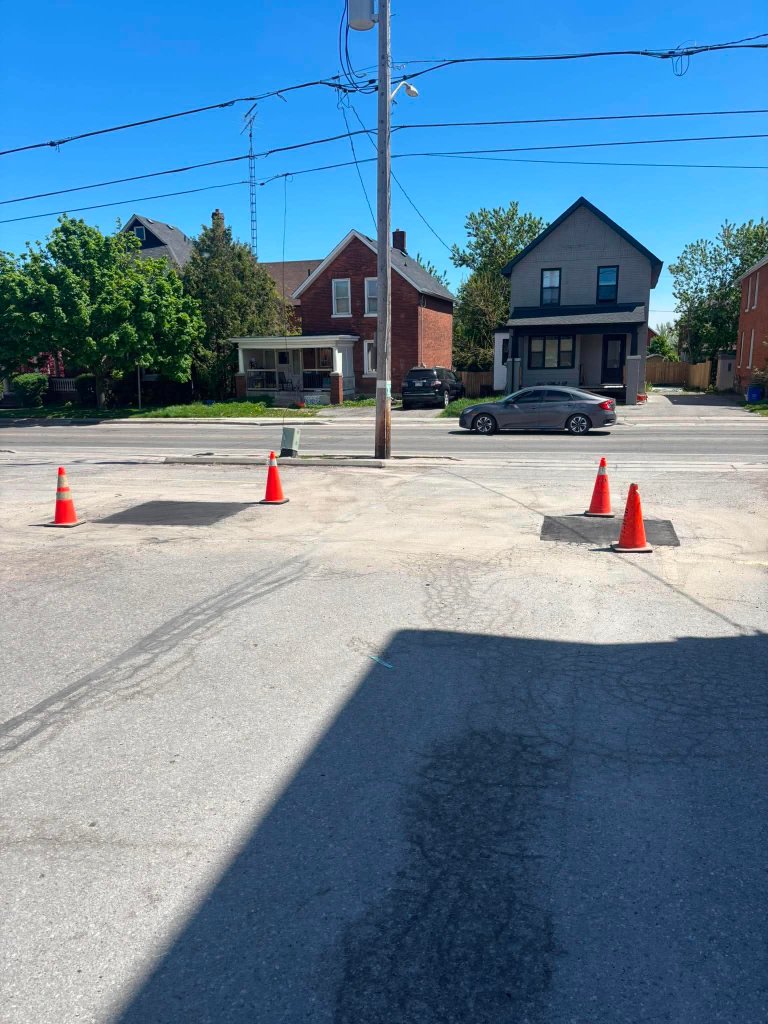
Pothole and patch repair. On our pothole repair jobs we saw-cut clean, straight edges around the damaged area so the new asphalt bonds tightly to the old. We fill with hot mix or cold patch asphalt, chosen for the repair size and the weather, and compact the patch to match the surrounding grade. Hot mix needs temperatures above 5°C. Cold patch can go in year-round, but it may need re-application sooner in high-traffic areas. A properly saw-cut and compacted hot mix repair lasts years.
Where a patch sits on a soft or sunken spot, the base under it has to be dealt with too. WAPA's repair for localized fatigue cracking and depressions is the same: remove the asphalt, dig out the poor subgrade, replace it, and patch over the repaired area.
When repair stops making sense. Texas A&M notes that patches typically deteriorate faster than the original pavement. If a driveway is turning into a quilt of patches, or the cracks are spreading into an alligator pattern, it is time to look at the options below.
Option 2: Driveway Resurfacing (an Overlay)
Resurfacing puts a new layer of asphalt over the existing driveway. OHMPA calls it overlaying and says it can rejuvenate an older driveway with excellent results, as long as the existing driveway is still structurally sound.
OHMPA's steps for an overlay:
- Patch or repair holes, cracks and soft areas first, or the trouble spots can work their way up through the new asphalt.
- Repair alligator cracking, because it will otherwise reappear in the new surface.
- Clean the old asphalt thoroughly and spray it with a tack coat, which bonds the new layer to the old.
- Place a new surface course 1.5 to 2 inches thick, shaped for drainage.
Resurfacing is a fit for a driveway that is faded, worn or covered in block cracking but still firm, level and draining properly. It is not a fit for a driveway with widespread alligator cracking, sinking areas or water sitting on it, because the new layer would sit on the same failing base.
Option 3: Driveway Replacement
Replacement means removing the old asphalt and rebuilding. OHMPA says removing and replacing is also an option for rejuvenating old driveways, that additional granular is typically needed for proper grade and drainage, and that any areas where the base has failed must be repaired by removing the existing granular and soft subgrade and replacing it with compacted crushed aggregate.
This is the scope our driveway paving crews follow. We remove old material to full depth, install multiple lifts of crusher run plate-compacted to spec, grade for positive drainage away from the garage and foundation, and install edge restraint. We handle demolition and disposal through to final sealing. We do not pave over a cracked base. For published average costs and what drives the price of a full rebuild, see our guide to how much an asphalt driveway costs in Ontario.
Repair vs Resurfacing vs Replacement at a Glance
| Repair | Resurfacing (overlay) | Replacement | |
|---|---|---|---|
| What it is | Fill cracks, patch potholes and local soft spots | New 1.5 to 2 inch asphalt layer over the old driveway, after repairs and a tack coat | Remove old asphalt, repair or rebuild the granular base, repave |
| Good fit when | Driveway is firm; damage is isolated | Driveway is structurally sound but worn, faded or block cracked | Base has failed; widespread alligator cracking, sinking or poor drainage |
| Not a fit when | Cracks form an alligator pattern or the area is sinking | Alligator cracking or soft areas are not repaired first | Damage is minor and the base is sound |
| Typical signs | Single straight cracks, one or two potholes | Block cracking, fading, many old patches on a firm base | Alligator cracking in wheel paths, depressions, recurring potholes |
A Quick Self-Check Before You Call
Walk the driveway on a dry day and again after rain. Note:
- Are the cracks single lines, or do they join into small pieces?
- Are there low spots where water sits after rain?
- Do potholes come back in the same place after patching?
- Does water run off toward the street, or toward the garage or house?
- Are there soft areas from oil or gas spills? OHMPA says these must be repaired before an overlay.
Mostly single cracks on a firm, well-drained driveway point to repair. Wear without structural signs points to resurfacing. Alligator cracking, sinking and standing water point to the base, and that usually means replacement of at least the failed areas.
If the main issue is a faded surface with fine cracks, sealing may be all it needs for now. Our guide to driveway sealing in Ontario covers when it helps and when it is too late.
Common Questions
Can you repair an asphalt driveway instead of replacing it?
Yes, if the damage is local and the base is sound. Single cracks can be filled and potholes can be saw-cut and patched. If the driveway has widespread alligator cracking or sunken areas, the base has likely failed and repairs will not last.
Is resurfacing a driveway the same as repaving?
People use the words loosely. Resurfacing usually means an overlay: a new 1.5 to 2 inch layer of asphalt over the existing driveway. Repaving often means removing the old asphalt and rebuilding, which is what you need when the base has failed.
When does a driveway need to be replaced?
When the problems come from below the asphalt. Alligator cracking, depressions that hold water and potholes that keep returning are signs of base or subgrade failure. OHMPA says failed base must be dug out and replaced with compacted crushed aggregate.
How long does an asphalt driveway last in Ontario?
OHMPA says a well-designed driveway will give virtually trouble-free service for up to 20 years. Design, base depth, asphalt thickness and drainage all affect how long a given driveway lasts.
Get a Free On-Site Quote
The right fix depends on what is under the asphalt, and that is easier to judge in person. We repair potholes with saw-cut, compacted patches, and we rebuild driveways from a compacted granular base up. Visit our driveway paving and pothole repair pages, then contact us for a free on-site quote anywhere in Durham Region.
Sources: Ontario Hot Mix Producers Association, The ABCs of Driveways; Texas A&M Transportation Institute, ACRP pavement distress list; Washington Asphalt Pavement Association, Alligator (Fatigue) Cracking; Washington Asphalt Pavement Association, Potholes; Washington Asphalt Pavement Association, Depression; Resisto, asphalt products comparative table.