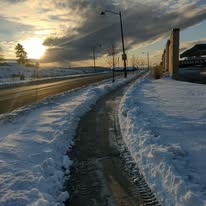
Slip and fall liability in Ontario for snow and ice starts with the Occupiers' Liability Act. Whoever occupies a property must take reasonable care to keep visitors reasonably safe, and since 2021 most snow and ice injury claims against an occupier or its snow contractor need written notice within 60 days. Good clearing, salting and dated records are the practical side of meeting that duty.
This guide explains the rules for owners and managers of homes, plazas, offices and industrial sites in Durham Region. It is general information, not legal advice. For your own situation, talk to a lawyer or your insurer.
Who Is Responsible for Snow and Ice on Private Property
The Act puts the duty on the "occupier", not only the owner. Section 1 defines an occupier as a person in physical possession of the premises, or a person who has responsibility for and control over the condition of the premises, the activities carried on there, or the people allowed to enter. The definition also says a property can have more than one occupier at the same time.
In practice, that can mean an owner, a tenant who controls the space, or a property manager, depending on who actually controls the site. Section 8 adds that a landlord who is responsible for maintenance or repair under a tenancy owes the same duty of care for dangers that come from failing to carry out that responsibility.
Section 3 sets the duty itself. An occupier must take "such care as in all the circumstances of the case is reasonable" to see that people entering, and the property they bring, are reasonably safe. The duty applies whether the danger comes from the condition of the premises, such as ice on a walkway, or from an activity carried on there.
What Reasonable Care Means When It Snows
The Act does not set a clearing time, a salt rate or a number of visits. The test is what is reasonable in all the circumstances, so the answer for a corner store differs from the answer for a 24-hour distribution centre. Whether care was reasonable depends on the facts, which is one reason no blog post can tell you what is enough for your property.
What owners can control is a clear, repeatable routine:
- Decide which areas people actually use: entrances, walkways, stairs, ramps, accessible parking and the route from the lot to the door.
- Clear and treat those areas during and after storms, not only once the snow stops.
- Watch for melt and refreeze, where water from snow piles runs across a walkway and freezes overnight.
- Keep a record of what was done and when.
Hiring a Snow Contractor Does Not End the Duty
Many owners assume that once a contractor is hired, the snow is the contractor's problem. The Act is more careful than that. Under section 6(1), an occupier is not liable for damage caused by the negligence of an independent contractor if, in all the circumstances, the occupier acted reasonably in entrusting the work to the contractor and took the steps it reasonably ought to in order to be satisfied that the contractor was competent and that the work had been properly done.
Two points follow. First, choosing the contractor matters, and our guide on how to choose a snow removal contractor covers what to compare. Second, checking the work matters too, which is where visit records come in. Section 6(3) also says nothing in that section affects any duty of the occupier that is non-delegable at common law, so ask your lawyer how this applies to your property.
Ontario's 60-Day Notice Rule for Snow and Ice
Bill 118, the Occupiers' Liability Amendment Act, 2020, received royal assent on December 8, 2020 and added section 6.1 to the Act. The section has been in force since January 29, 2021. It covers lawsuits for personal injury caused by snow or ice against an occupier, or against an independent contractor the occupier employed to remove snow or ice during the relevant period.
| Question | What section 6.1 says |
|---|---|
| What is required | Written notice of the claim, including the date, time and location of the occurrence |
| Deadline | Within 60 days after the injury |
| How it is delivered | Personally served or sent by registered mail |
| Who can receive it | At least one of: the occupier, or the snow and ice removal contractor the occupier employed at the time |
| If the occupier receives it | It must serve a copy personally or by registered mail on any other occupiers of the premises during that period and on any snow removal contractor it employed then |
| If the contractor receives it | It must serve a copy personally or by registered mail on the occupier that employed it |
| Exceptions | Missing notice is not a bar if the injured person died as a result of the injury, or if a judge finds a reasonable excuse for missing or insufficient notice and that the defendant is not prejudiced in its defence |
Subsection 6.1(7) closes a gap that owners sometimes miss. Once proper notice reaches any one of the listed people, the 60-day limit no longer applies, even to a claim against someone who did not receive the notice. In other words, notice served only on the owner still counts for a claim against the contractor, and the reverse is also true.
The rule is about notice, not about who is at fault. A notice that arrives on time does not mean the owner was careless, and a missed notice does not always end a claim because of the exceptions above.
Public Sidewalks Follow Different Rules
A fall on the public sidewalk in front of your property is usually a different legal question. Section 10(2) of the Occupiers' Liability Act says the Act does not apply to a municipal corporation where it is the occupier of a public highway or public road.
Claims against a municipality fall under section 44 of the Municipal Act, 2001. Under section 44(9), except in case of gross negligence, a municipality is not liable for a personal injury caused by snow or ice on a sidewalk. Section 44(10) requires written notice to the municipal clerk within 10 days of the injury, with the date, time and location, served or sent by registered mail. As with the 60-day rule, late notice is not a bar in the case of death, or where a judge finds a reasonable excuse and no prejudice to the municipality.
None of this removes the by-law duty to clear the sidewalk. The Town of Whitby, for example, requires owners to clear ice and snow from the sidewalks and walkways bordering their property within 24 hours of a snowfall, and may clear it and charge the owner if they do not. Deadlines differ across the Region, so see our snow clearing rules for Durham Region for each town, and confirm with your municipality because by-laws change.
If a Notice Arrives
A notice can arrive weeks after the storm, when nobody remembers the day clearly. A short checklist helps:
- Write down the date you received the notice and how it arrived.
- Call your insurer and, if you have one, your lawyer.
- Serve the copies section 6.1 requires: an occupier copies other occupiers and its snow contractor; a contractor copies the occupier that hired it.
- Pull every record for the date, time and location named in the notice: visit logs, photos, weather notes and any incident report.
- Do not change or discard records for that period.
Records That Help
Good records will not decide a claim on their own, but they replace "I think we were there" with a dated answer. Useful records include:
- the time each visit started and finished,
- photos of entrances, walkways and stairs after clearing,
- conditions at the time, such as snowfall, freezing rain or refreeze,
- what was applied and how much,
- any complaint or incident reported by staff or visitors.
On our commercial snow removal and industrial snow removal contracts, salt or calcium chloride is applied after every plow visit, and every visit is logged with a timestamp, photos, conditions and salt application rates. Dispatch follows real-time weather monitoring, with pre-treatment before major events. That per-event record supports your slip-and-fall liability management.
Residential contracts work differently. They cover plowing and shovelling of the driveway, walkways, sidewalks and porch or front entrance, dispatched once 2 inches has fallen, and they do not include salting. Homeowners who salt their own steps should keep their own simple note of when they did it. Our snow removal tips compare common ice melts.
Common Questions
Who is liable for a slip and fall on ice in Ontario?
On private property, the occupier owes the duty of reasonable care under section 3 of the Occupiers' Liability Act, and a snow removal contractor can also be named. On a municipal sidewalk, claims against the municipality fall under section 44 of the Municipal Act, 2001. Who is actually liable depends on the facts, which is a question for a lawyer.
How long do you have to report a slip and fall on snow or ice?
For snow or ice on private property, written notice must be served personally or by registered mail within 60 days. For snow or ice on a municipal sidewalk, notice goes to the municipal clerk within 10 days. Both laws have exceptions for death and for a reasonable excuse where the defendant is not prejudiced.
Does a snow removal contract protect the property owner?
It can help, but it does not end the owner's duty. Section 6 of the Act protects an occupier from a contractor's negligence only where the occupier acted reasonably in hiring a competent contractor and checking the work. Records of each visit show that the work was done.
Do residential snow contracts include salting?
Ours do not. Residential contracts cover plowing and shovelling only, and salting is part of our commercial and industrial contracts.
Snow Service With a Record of Every Visit
We clear commercial, industrial and multi-unit properties across Durham Region, with contracts that run November 1 to April 15 and are signed in September and October. See local details for Oshawa, Whitby, Ajax and Pickering, then contact us for a free on-site quote anywhere in Durham Region.
Sources: Ontario e-Laws, Occupiers' Liability Act, R.S.O. 1990, c. O.2; Ontario e-Laws, Occupiers' Liability Amendment Act, 2020, S.O. 2020, c. 33; Legislative Assembly of Ontario, Bill 118, Occupiers' Liability Amendment Act, 2020; Ontario e-Laws, Municipal Act, 2001, section 44; Town of Whitby, Sidewalk Snow Clearing.