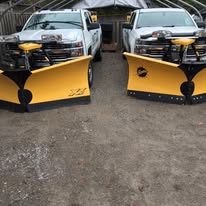
Industrial snow removal in Pickering is about more than an open parking lot. On a plant or warehouse site, the City expects fire access routes on private property to stay passable all winter, private hydrants to stay visible and reachable, and the surfaces your workers use to stay free of snow and ice. Michael Durham Landscaping plows and salts industrial properties in Pickering on fixed-price seasonal contracts, with the clearing order agreed in writing before the first storm.
What Our Industrial Contracts Include
Our industrial snow removal service is built for plants, warehouses and industrial units:
- A site review before the season. We walk the property with you and set out, in writing, which areas are cleared first, so crews know the order when snow arrives overnight.
- Weather-monitored dispatch, with surfaces pre-treated before major events.
- Salt or calcium chloride after every plow visit.
- Time-stamped logs for every visit, with photos, conditions and salt application rates.
- A fixed-price seasonal contract from November 1 to April 15, signed in September and October.
Pickering Rules That Matter on Industrial Sites
Fire routes must be kept clear at all times
Pickering's Property Standards By-law 7887/21 applies to all areas of commercial, industrial and institutional property that the public has access to. It says exterior parking areas and fire routes, including laneways, are to be kept free from accumulations of ice and snow at all times, and that walkways, stairways and access routes to and from buildings are kept free from ice, snow and hazards.
The City's Fire Services Development Guidelines go a step further for private land. Section 9.1 says emergency access routes, temporary emergency access routes and fire access routes on private property must remain clear of parked vehicles and obstructions, be passable at all times, and have snow and ice removed, including routes that are not part of the City's winter control program. The same guidelines describe fire access routes with a clear width of at least 6 metres, so plan where plowed snow goes before it narrows that width.
At the provincial level, Article 2.5.1.3 of the Ontario Fire Code says fire access routes shall be maintained so as to be immediately ready for use at all times by fire department vehicles, and Article 2.7.1.8 says exterior passageways, exterior stairways and fire escapes in occupied buildings must be kept free of snow and ice accumulations.
Signed fire routes and private hydrants
Under Pickering's Traffic and Parking By-law 6604/05, no one may park on a roadway or laneway on private property that is signed "No Parking, Fire Route". The City's parking page lists parking in a fire route and parking within 3 metres of a fire hydrant among the offences it enforces. A trailer moved into a signed fire route so the lot can be plowed defeats the purpose of the sign.
The Fire Services guidelines say private hydrants are to be kept visible and accessible at all times, with no obstructions within a 1 metre radius (they name trees, shrubs, fences and retaining walls), and that they are tested and maintained every year at the owner's expense under the Fire Code. We mark hydrants during the site review so snow storage is planned away from them.
Workers' surfaces under Ontario's industrial regulation
For industrial establishments, section 11 of Ontario Regulation 851 says a floor or other surface used by any worker shall be kept free of obstructions, hazards, and accumulations of refuse, snow or ice. That includes the outdoor paths staff walk between buildings. This is general information, not legal advice; speak with your lawyer, insurer or health and safety advisor about your own obligations.
Rules change, so confirm current requirements with the City of Pickering before the season.
Planning Priorities Around Shifts and Truck Traffic
An industrial site often runs on shifts, and its first arrivals may be drivers, not office staff. During the site review we agree on an order that suits your operation, for example the fire route and hydrants first, then the truck entrance and staff walkways, then the main lot.
Pickering's Traffic and Parking By-law defines a heavy vehicle as one over 4,500 kilograms gross weight and bars heavy vehicles from the streets listed in its Schedule 10, with an exception for deliveries to premises that can only be reached by that street. It also sets a reduced load period on City roads from March 1 to April 30 each year, apart from the roads listed in Schedule 12. The routes your suppliers use into your gate are the ones to keep wide and salted.
Pickering is adding employment land too. The City's Pickering Innovation Corridor summary describes about 800 acres at the north edge of Seaton, bordered by Highway 7, Brock Road and Highway 407, zoned for prestige industrial and office uses. New buildings there bring their own fire access routes and hydrants to plan around.
When salt runs short
In January 2026 the City posted a province-wide salt shortage update saying a blend of salt, sand or other de-icing materials could be used in some areas, so more sand may appear on roads and sidewalks. Our contracts call for salt or calcium chloride after every plow visit, and the log records the application rate each time.
Records You Can Hand to Your Safety Team
Every visit is logged with the time, photos, conditions and salt rates. On an industrial site, they show when the fire route, hydrant areas and worker paths were last cleared, which is useful for your safety files and any slip and fall claim.
Common Questions
Does Pickering plow the fire routes on my industrial property?
No. The City's Fire Services Development Guidelines say snow and ice must be removed from fire access routes on private property, including routes outside the City's winter control program.
How close can snow be piled to a private hydrant in Pickering?
The City's guidelines call for no obstructions within a 1 metre radius of a private hydrant and say hydrants are to stay visible and accessible at all times. We plan storage areas well away from hydrants during the site review.
Can we move trailers into the fire route while the lot is plowed?
Pickering's Traffic and Parking By-law prohibits parking in a signed fire route on private property, and the guidelines say fire access routes must stay clear of parked vehicles. Agree on a plowing sequence that does not rely on the fire route as a holding area.
Book a Pickering Industrial Site Review
Contact us in September or October to book a site review and a free quote for your Pickering industrial property. For retail and office sites, see commercial snow removal in Pickering; for a Durham-wide overview, read our snow clearing rules guide; and for the rest of your grounds, see landscaping in Pickering.
Sources: City of Pickering, Property Standards By-law 7887/21; City of Pickering, Fire Services Development Guidelines; City of Pickering, Traffic and Parking By-law 6604/05; City of Pickering, Parking; City of Pickering, Snow Removal and Clearing; City of Pickering, Pickering Innovation Corridor; Ontario e-Laws, Fire Code, O. Reg. 213/07; Ontario e-Laws, Industrial Establishments, R.R.O. 1990, Reg. 851.